Shared Media Wmc Marked Read Only Can't Delete
 Windows Media Center on Windows 8.1 Pro. | |
| Developer(s) | Microsoft |
|---|---|
| Operating system | Included with:
Also available for:
|
| Predecessor | DVD Player (Windows) |
| Successor | Windows DVD Histrion (Windows 10) |
| Type | Digital video recorder and media role player |
| Website |
|
Windows Media Heart (WMC) is a defunct digital video recorder and media histrion created by Microsoft. Media Center was first introduced to Windows in 2002 on Windows XP Media Center Edition (MCE). It was included in Home Premium and Ultimate editions of Windows Vista, as well equally all editions of Windows 7 except Starter and Home Basic. It was also available on Windows 8 Pro and Windows eight.ane Pro equally a paid add-on, earlier being discontinued in Windows 10, although information technology tin can reportedly be unofficially reinstalled using a serial of Command Prompt commands.[one] [2] [ ameliorate source needed ]
Media Center can play slideshows, videos and music from local hard drives, optical drives and network locations. Users tin can stream goggle box programs and films through selected services such equally Netflix. Content tin can be played back on computer monitors or on telly sets through the use of devices called Windows Media Center Extenders. It is also possible to watch and pause live TV. Up to half dozen TV tuners on a tuner card are supported simultaneously. Both standard- and high-definition unencrypted video are supported through DVB-T and ATSC standards. It is possible to view encrypted cable idiot box channels past using an internal or external tuner that supported CableCARD.
Shortly subsequently Windows 7'due south 2009 release, Microsoft disbanded the Media Center evolution team, thus abandoning any further software developments. Consequently, the Media Center interface remained unchanged for Windows 8 and viii.1 users. In May 2015, Microsoft announced that Windows Media Center would be discontinued on Windows 10, and that it would be removed when upgrading; but stated that those upgrading from a version of Windows that included the Media Center application would receive the paid Windows DVD Player app for gratuitous to maintain DVD playback functionality.[three]
Version history [edit]
Windows XP Media Center Edition [edit]
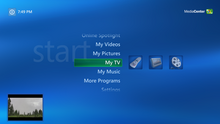
Windows Media Center, codenamed "Freestyle", was beginning included with Windows XP Media Center Edition.
Windows Vista [edit]
A new version of the WMC was included in the Home Premium and Ultimate Windows Vista editions. The user interface was redesigned and tailored for the sixteen:9 aspect ratio. Support for multiple tuners was added in later releases and varies depending upon the version of the operating arrangement purchased. Back up for many Windows Media Heart Extender hardware devices, that had been released pre-Vista, was also dropped leaving many owners out of luck if they did not upgrade to one of the supported Windows Vista versions from the Windows XP Media Center Edition. Also introduced to U.S. users was Net TV, which allows admission to streaming content through WMC. It also allows video game content.
Each push in the main menu, which contains sections such every bit "Music", "Videos", and "TV", gets encased in a box when selected, and for each selection, a submenu comes upward, extending horizontally. When whatever of the options is selected, the entries for each are presented in a filigree-like structure, with each item existence identified past anthology fine art, if it is an audio file, or a thumbnail image if information technology is a picture, a video or a TV recording, and other related options, such as unlike views for the music drove if "Music" is selected, extend horizontally along the summit of the grid. Similarly, other items are identified by suggestive artwork. The filigree displaying the items is also extended horizontally, and the selected item is enlarged compared to the rest. Other features of the WMC include:
- Back up for two dual-tuner cards.
- Native DVD/MPEG-2 support.
- Add-on of Movies and DVD button which lists all the movies on the hard drive and DVD.
- Tasks push that provides admission to jobs such as setting up and configuring a media middle extender device.
- Any video playing is overlaid on the background of the user interface, if the UI is navigated while the video is still playing.
- Back up for high-definition (HD) content, and CableCARD support.
- Uses the .Internet ii.0 CLR.
Microsoft later updated WMC with a feature pack known every bit TV Pack 2008.[iv] This release, codenamed "Fiji", was only made available via OEMs for new computers that came preinstalled with the update. Information technology is not available as an update for existing WMC users.[5] [vi] [7] The update tweaked the user interface, added support for digital subchannels, QAM, DVB-S and MHEG, and increased the full number of each type of tuner allowed. Information technology used .wtv files instead of .dvr-ms.[viii] [9] Beta versions besides supported H.264 format simply this feature was removed upon release to manufacturing.[10]
Windows 7 [edit]
An updated version of the WMC was included in all the Windows seven editions except Starter and Habitation Basic. Much of the functionality added with TV Pack 2008 was included with the version of Media Center included in Windows 7, along with an update to the user interface.[11]
The WMC has retained much of the design and feel of its predecessor, but with a variety of user interface shortcuts and browsing capabilities.[12] Playback of H.264 video both locally and through a Media Middle Extender (including the Xbox 360) is supported.
Some notable enhancements in the WMC include a new mini guide, a new scrub bar, the option to color code the guide past evidence type, and Internet content that is more than tightly integrated with regular TV via the guide. All Windows 7 versions now back up up to iv tuners of each blazon (QAM, ATSC, CableCARD, NTSC, etc.).
When browsing the media library, items lacking album fine art are shown in a range of foreground and groundwork color combinations instead of using white text on a bluish background. When the left or right remote control buttons are held down to scan the library quickly, a ii-letter prefix of the current anthology name is prominently shown as a visual aid. The Picture Library includes new slideshow capabilities, and individual pictures can be rated.
Also, while browsing a media library, a new column appears at the top named "Shared." This allows users to admission shared media libraries on other Media Middle PCs from straight within Media Center.
For tv support, the Windows Media Eye "TV Pack" released past Microsoft in 2008 is incorporated into the WMC. This includes back up for CableCARD and North American (ATSC) clear QAM tuners, as well as creating lists of favorite stations.[xiii]
A gadget for the WMC is also included.[14]
The Public binder as well contains a hidden Recorded TV library that appears in the Windows Explorer side pane when TV is set up in Media Center for the first time.
Windows 8 and 8.1 [edit]
The WMC was not included with any of Windows eight editions.[15] Instead, it was part of a Windows eight Media Eye Pack add together-on available only for retail versions[sixteen] Windows 8 Pro, and Windows 8 Pro Pack that upgrades Windows 8 to Windows viii Pro[17] available through the Add features to Windows 8 service. The Windows 8 Pro Pack was available for Usa$69.99,[18] while the Windows 8 Media Center Pack was available at no charge from October 26, 2012, until January 31, 2013, as a promotion to encourage users to upgrade to Windows 8.[19] After the promotion, the toll of the Windows 8 and viii.1 Media Heart Pack changed to United states of america$9.99,[18] until information technology was discontinued on Oct 30, 2015.[20]
The WMC cannot run on startup or on top of other windows because of "new Windows Os requirements and behaviors".[21] [22]
Windows 10 Technical Preview [edit]
On Windows 10 Technical Preview builds, adding Windows Media Center using a purchased Windows viii.i product central would result in the system subsequently identifying itself as "Windows 8.1 Pro with Media Center", along with a warning that the Bone has non been activated. The issue as well prevented users from getting updates, patches and future preview builds.[23]
Discontinuation [edit]
During the 2015 Build developers' conference, a Microsoft executive confirmed that Media Center, with its TV receiver and PVR functionality, would not be updated for or included with Windows 10; thus the product would be discontinued. Those upgrading to Windows 10 from a version of Windows that included the Media Heart application would receive the paid Windows DVD Player app for complimentary to maintain DVD playback functionality[3] after the commencement Windows Update.[24] [25]
Some users who wanted Microsoft to provide an official port of the Windows Media Center for Windows 10 created two change.org petitions and sent thousands of requests to Microsoft via their Windows Feedback app included with Windows ten.
Electronic Programme Guide [edit]
In early on July 2015, Microsoft appear that the Electronic Program Guide (EPG) for Windows Media Center was being updated on July vii, 2015 with new video data packages.[26] [27] This update to the EPG changed the service provider from Zap2It to Rovi. Since the update a large number of reports have been posted to the Microsoft Media Center Feedback page[28] indicating that the EPG data feed from Rovi has significant information quality issues relating to wrong channel lineups, outdated and wrong program data and failure to download the EPG data from Rovi through Microsoft's servers. This update was non given to the early Insider Preview builds of Windows 10 even though they included the WMC.
Program Guide Data Service [edit]
Back up for Electronic Plan Guide service officially ended on January fourteen, 2020, coinciding with the end of back up for Windows 7. [29] [30] This applies to all versions of WMC including users running WMC on discontinued products such as XP and Vista. Despite the announcement, EPG data continued to exist updated until the first week of April 2020. Alternatives be that acquire program information and load information technology into the WMC EPG data base.[31] Some employ fee-based subscription services to obtain the data. Some require multiple processing steps but are more often than not automatable.
Some alternate Television set listing providers are:
- epg123 (free software that lets WMC get EPG data from other sources)
- WebGrab+Plus (standalone EPG software)
- SchedulesDirect (provides EPG data for software like EPG123, at a cost of $25 per yr)
- EPG Collector (open-source software to insert over-the-air EPG information into Windows Media Middle 7)
Some DVR-like alternatives to WMC that support Plan Guide Data:
- Emby DVR – toll $5 per month, $55 for i twelvemonth or $119 for lifetime
- Plex – cost $v per month, $39 for 1 yr, or $119 for Lifetime
- SiliconDust Dvr – $35 per year
- JRiver – Windows license $60
- MediaPortal – unknown
Features [edit]
Media Centre uses TV tuner devices to play back and record TV shows from standard antenna, cable or satellite signals. Users tin record television programs manually or schedule recording via the electronic programme guide. Recordings can be burned to Video DVD or, barring copy restrictions, be transferred to a portable media player. Media Center supports both analog and digital tuners and allows up to six of each tuner type (analog, digital terrestrial, Clear QAM, CableCard) to be configured. All the tuners use the same guide data but it can be edited and configured to include additional channels such as Clear QAM non constitute or included in most Titan Guides. While playing alive boob tube, the program keeps a buffer that allows users to rewind or pause live Telly and skip commercials. A third party program MCEbuddy allows automated commercial skipping on recorded programs.
Media Middle can stream both live and recorded contents to Windows Media Eye Extenders such as the Xbox 360 console, but other Windows computers tin just access recorded content. Playback of content on television is possible through Media Center Extenders or by directly connecting a computer running Windows Media Center to a tv. The menus of Windows Media Center are displayed in a 10-foot user interface suitable for viewing on large screen televisions and can exist navigated using diverse remote controls. Windows Media Center PCs require a sensor to exist able to collaborate with the remote command. To annunciate Media Center support, remote controls must also accept certain buttons such as the Light-green Media Heart logo Outset push button and buttons for navigation, playback and volume controls, power and channel flipping.[32] [33]
Media file back up [edit]
Windows Media Eye organizes and displays videos and music found on both local and networked computers. Music albums are arranged with accompanying album fine art that can exist downloaded off the Internet automatically or added manually into Media Center. Users can create playlists of unlike songs or albums likewise. While playing music, the user tin pause and fast forward songs and view visualizations. Analog FM radio back up is also available if the user'southward Goggle box tuner supports it.
Media Centre allows users to scan pictures and play them in slideshows, likewise as play video files. Media can be categorized by name, date, tags, and other file attributes. In addition, users tin organize and play films through the "Movie Library" feature introduced in Windows Vista Media Heart. Through the "Internet Boob tube" feature, users tin can besides stream television and spider web shows from select content providers.
CableCARD support [edit]
Windows Vista Media Center introduced support for CableCARD devices. Nevertheless, CableCARD was only supported on OEM hardware that had been certified by CableLabs.[34] Windows 7 Media Center supports adding CableCARD to existing hardware, provided the hardware meets certain requirements.[35] Before long after the release of Windows 7, Microsoft released the Digital Cable Advisor tool to verify that the requirements are met before activating CableCARD support.[36]
Portable devices [edit]
Windows Media Center allows synchronization with certain portable devices. These devices include Windows Mobile Pocket PCs, smartphones, Portable Media Centers and other players that can sync with Windows Media Player. Microsoft'due south Zune cannot use the sync function, but can play Media Center recorder TV files when they are copied to a Zune monitored folder.
While synchronizing television shows, Windows Media Center encodes the shows using Windows Media Encoder to a Windows Media Video format at a lower quality than the original format used for viewing on the desktop media centre. This is to complement the limited storage space and processing power of such portable devices. Optionally, music can as well exist re-encoded to a smaller file size upon synchronization.
Application development [edit]
Windows Media Heart was designed equally a programmable platform; other programs can tie into the Media Center UI using the WMC API, which is provided equally a managed API. The functionality of Windows Media Center can be extended by three different types of applications:[37]
Presentation Layer Applications [edit]
These are managed applications written using the WMC API and packaged as CLI assemblies. Presentation Layer applications can have full access to both the .NET Framework likewise every bit the Windows Media Centre API, with the latter exposing a managed object model to access and dispense the electric current states of the media management and playback, live television, video recording as well equally the presentation capabilities of Windows Media Middle. Presentation Layer applications are rendered using the bitmap-based Windows Media Middle Presentation Layer, the user-input and presentation arrangement of WMC. Presentation Layer includes back up for animations, dynamic layout, keyboard/mouse also as remote navigation. Presentation Layer applications tin be streamed over RDP to Windows Media Center Extenders; and then Presentation Layer applications run on the extenders without any modification. Presentation Layer, however, exists only in the Windows Vista version of WMC.[37] [38]
Presentation Layer applications are created using an XML based declarative markup language, known as Media Center Markup Linguistic communication (MCML). MCML is used to define the user interface, with animation, text input, navigation, data binding, and local storage support available from the markup itself. If custom code or other functionality is required to implement a certain feature, CLI assemblies can be referred. Any CLI language can be used to write the code-behind assemblies that implement the required functionality. An MCML document defines the interface as a drove of UI elements, each exposing four attributes: Content which defines what that UI element will display, Properties to control the presentation aspects of the element, Locals which enumerate the set of individual state data for the element, and Rules which permit the attributes to be modified based on certain triggers. By modifying these attributes at runtime, either from markup or code behind classes, the interface is generated.[39]
Presentation Layer applications can either exist locally installed, or downloaded from the spider web equally necessary. Still, in the latter example, the code is untrusted; only the .NET classes that are marked as safe for use by Internet-originating lawmaking can exist used. Before an application can be used, information technology has to be registered with Windows Media Middle. An application tin either register itself as a pinnacle-level menu detail, in any of the sub-menus (depending on the type of awarding), equally an autoplay handler, into the Program Library (the card category for all programs), or every bit a background application without a user interface running equally long every bit a WMC session continues.[40] [41]
XAML Browser Application [edit]
WMC can also act every bit host for XAML Browser Applications (XBAP), which are rendered in the WMC UI itself. XBAPs are rendered using the vector-based resolution-independent Windows Presentation Foundation component of .Cyberspace Framework 3.0. XBAPs have their UI written in XAML with code behind in any .Internet language. XBAPs are also limited to Windows Vista. WMC provides limited support for streaming XBAPs to Windows Media Center Extenders. XBAPs have been alleged deprecated in Windows Media Middle SDK version 5.three.
Hosted HTML Applications [edit]
WMC can host Net Explorer within its own UI (using WMC UI widgets) and can brandish spider web pages and web applications. This characteristic is supported in both Windows XP and Windows Vista. Web applications written specifically for being hosted in WMC can use a subset of the WMC API which is exposed via JavaScript. HTML applications are also not fully supported for streaming to extenders.
See too [edit]
- Kodi (a costless, open-source, and cross-platform media middle software)
- Comparison of DVR software packages
- MediaPortal
- Microsoft Mediaroom
- Personal video recorder
- XrossMediaBar
References [edit]
- ^ "Possible to port WMC from Win10 Preview builds to Final?". www.thegreenbutton.television set. Dec 30, 2015. Retrieved January 24, 2020.
- ^ "[Word] Patch WMC to run on Windows x last & possible alternatives". forums.mydigitallife.net. January 22, 2020. Retrieved January 24, 2020.
- ^ a b Paul, Ian (July 29, 2015). "How to play DVDs in Windows 10 for free". PCWorld. IDG.
- ^ "Error message when yous open up Windows Media Center TV Pack and tune to a channel that is listed in the Electronic Plan Guide: 'No TV Signal' (Revision: 2.5)". Microsoft Support. Microsoft Corporation. July 17, 2008. Archived from the original on October 24, 2012. Retrieved December 31, 2010.
- ^ "Microsoft Corp removes 'Fiji' from Windows". The Fiji Times Online. Fiji Times Limited. June 28, 2008. Archived from the original on June 28, 2008. Retrieved December 31, 2010.
- ^ Lanier, Chris (August viii, 2008). "Microsoft Makes Fiji Official, TV Pack for OEMs Just". Chris Lanier MVP blog. Microsoft. Archived from the original on Baronial 12, 2008. Retrieved December 31, 2010.
- ^ Toll, Christopher (Nov 1, 2008). "Vista Service Pack 2 Lacks Media Center Television receiver Pack 2008". Christopher Price blog. Archived from the original on December sixteen, 2008. Retrieved Dec 2, 2008.
- ^ Drawbaugh, Ben (July 5, 2008). "No DirecTV HD for Windows Vista Media Center until 2010?". Engadget HD. AOL. Archived from the original on July 6, 2008. Retrieved December 31, 2010.
- ^ Drawbaugh, Ben (July 17, 2008). "Windows Media Centre TV Pack was released yesterday". Engadget HD. AOL. Archived from the original on July 23, 2008. Retrieved Dec 31, 2010.
- ^ Foley, Mary Jo (August five, 2008). "Microsoft sending mixed messages about Windows futures with 'Fiji'?". ZDNet. CBS Interactive. Retrieved December 31, 2010.
- ^ Drawbaugh, Ben (July 27, 2009). "Windows 7 Media Center Review". Engadget Hard disk. AOL. Archived from the original on November 27, 2009. Retrieved Dec 31, 2010.
- ^ Owen, Charlie (October 28, 2008). "Windows Media Center in the PDC Build of Windows 7". Microsoft. Archived from the original on October 31, 2008. Retrieved Nov eleven, 2008.
- ^ Drawbaugh, Ben (August 6, 2008). "Easily-on with the Vista Media Center TV Pack". Engadget HD. Archived from the original on August 8, 2008. Retrieved November xi, 2008.
- ^ Thurrott, Paul (October half dozen, 2010). "Windows 7 Feature Focus: Windows Gadgets". SuperSite for Windows. Penton. Archived from the original on January v, 2013. Retrieved June fifteen, 2015.
- ^ LeBlanc, Brandon (April sixteen, 2012). "Windows Team Blog: Announcing the Windows 8 Editions". Blogging Windows. Microsoft. Archived from the original on August two, 2014.
- ^ ""Add features" option is unavailable in volume license versions of Windows 8". Support. Microsoft. Dec 21, 2012.
- ^ Caldas, Bernardo; Averett, Linda (May iv, 2012). Sinofsky, Steven (ed.). "Making Windows Media Center available in Windows 8". Building Windows 8. Microsoft. Archived from the original on May 4, 2012.
- ^ a b "How to add together Windows Media Center to Windows viii free of charge". October 31, 2012. Retrieved September 5, 2016.
- ^ "Running Windows 8 Pro? Go the Windows 8 Media Center Pack for Free!". December 10, 2012. Retrieved September 5, 2016.
- ^ "Windows 8 and viii.1 Pro Pack and Media Pack are No Longer Available to Purchase". Support.Microsoft.com . Retrieved September 6, 2016.
- ^ "Windows 8 Release Preview - Media Centre Issue?". Microsoft. June iv, 2012. Retrieved June 24, 2012.
- ^ Drawbaugh, Ben (June 23, 2012). "Two more nails in the coffin for Media Center, starting time-up options and tuner certification". Engadget. Aol. Retrieved June 24, 2012.
- ^ "Windows 10: If you're using the Technical Preview, don't install Media Heart". NeoWin.
- ^ Sams, Brad (May 2, 2015). "Windows Media Center is expressionless". Neowin . Retrieved May 3, 2015.
- ^ Bott, Ed (May 2, 2015). "R.I.P., Windows Media Heart". CNET. CBS Interactive. Retrieved May 3, 2015.
- ^ "Electronic Program Guide (EPG) for Media Center updated". Microsoft Back up. July 2015. Retrieved July 16, 2015.
- ^ Josh Pollard (July eight, 2015). "Microsoft Breathes New Life into Media Middle Guide". The Digital Media Zone . Retrieved July 16, 2015.
- ^ "Microsoft Connect". MEDIA CENTER Plan GUIDE Information FEEDBACK. Microsoft. Retrieved July 16, 2015.
- ^ "Windows 7 Stop of Back up - Microsoft 365". Microsoft.
- ^ "Windows message center".
- ^ "Microsoft ending EPG for WMC in January - TheGreenButton.tv".
- ^ "Understanding Mouse, Keyboard, Remote Control, and Touch Input". MSDN. Microsoft. Retrieved December 31, 2010.
- ^ "Required Remote Command Buttons". MSDN. Microsoft. Retrieved December 31, 2010.
- ^ Anderson, Nate (January 31, 2006). "CableCARD certification rules out dwelling house-built Windows MCE boxes, perchance other DIY solutions". Ars Technica. Condé Nast. Retrieved Nov 7, 2012.
- ^ "Microsoft Enhances the Digital Cablevision Experience and Names 2009 Windows Media Center Ultimate Install Winner". News Eye. Microsoft. September 9, 2009. Retrieved Nov 7, 2012.
- ^ "The Cable Chronicles: Win7 Digital Cable Counselor Released". AnandTech . Retrieved November 7, 2012.
- ^ a b "Windows Media Center SDK: Choosing a Engineering". MSDN. Microsoft Corporation. Retrieved December 31, 2010.
- ^ "Windows Media Center Presentation Layer Applications". MSDN. Microsoft Corporation. Retrieved December 31, 2010.
- ^ "Working with Media Center Markup Language". MSDN. Microsoft Corporation. Retrieved December 31, 2010.
- ^ "Creating, Installing, and Running a Windows Media Center Presentation Layer Application". MSDN. Microsoft Corporation. Retrieved December 31, 2010.
- ^ "Associating Awarding Entry Points with Integration Locations". MSDN. Microsoft Corporation. Retrieved December 31, 2010.
External links [edit]
- Official website: current support commodity
- Official website: last archive.org copy of defunct total site
- The Dark-green Button Forum
- The Media Center Sandbox: Official developer's forum
- Windows Experts Customs: Official user forum
Source: https://en.wikipedia.org/wiki/Windows_Media_Center
0 Response to "Shared Media Wmc Marked Read Only Can't Delete"
Post a Comment