Relevance Vector Machine Tutorial or Survey or Review or Introduction or Outline
 Relevance Vector Auto (RapidMiner Studio Core)
Synopsis
This operator is an implementation of Relevance Vector Machine (RVM) which is a probabilistic method both for nomenclature and regression.Description
The Relevance Vector Machine operator is a probabilistic method both for nomenclature and regression. The implementation of the relevance vector motorcar is based on the original algorithm described by 'Tipping/2001'. The fast version of the marginal likelihood maximization ('Tipping/Faul/2003') is also available if the rvm blazon parameter is set to 'Constructive-Regression-RVM'.
A Relevance Vector Machine (RVM) is a auto learning technique that uses Bayesian inference to obtain parsimonious solutions for regression and classification. The RVM has an identical functional grade to the support vector automobile, but provides probabilistic nomenclature. It is actually equivalent to a Gaussian process model with a certain covariance part. Compared to that of support vector machines (SVM), the Bayesian conception of the RVM avoids the set of free parameters of the SVM (that usually crave cantankerous-validation-based post-optimizations). Yet RVMs use an expectation maximization (EM)-similar learning method and are therefore at chance of local minima. This is unlike the standard sequential minimal optimization(SMO)-based algorithms employed past SVMs, which are guaranteed to find a global optimum.
Input
-
 training set (Data Tabular array)
 This input port expects an ExampleSet. This operator cannot handle nominal attributes; it can be applied on data sets with numeric attributes. Thus frequently you may have to apply the Nominal to Numerical operator earlier the application of this operator.
Output
-
 model (Kernel Model)
 The RVM is applied and the resultant model is delivered from this output port. This model can now exist applied on unseen data sets.
- instance fix (Data Table)
The ExampleSet that was given equally input is passed without changing to the output through this port. This is usually used to reuse the aforementioned ExampleSet in further operators or to view the ExampleSet in the Results Workspace.
Parameters
- rvm_typeThis parameter specifies the type of RVM Regression. The following options are available: Regression-RVM, Nomenclature-RVM and Constructive-Regression-RVM. Range: selection
- kernel_typeThe type of the kernel function is selected through this parameter. Following kernel types are supported: rbf, cauchy, laplace, poly, sigmoid, Epanechnikov, gaussian combination, multiquadric Range: pick
- kernel_lengthscaleThis parameter specifies the lengthscale to be used in all kernels. Range: existent
- kernel_degreeThis is the kernel parameter degree. This is only bachelor when the kernel blazon parameter is ready to polynomial or epachnenikov. Range: real
- kernel_biasThis parameter specifies the bias to be used in the poly kernel. Range: real
- kernel_sigma1This is the kernel parameter sigma1. This is simply available when the kernel type parameter is set to epachnenikov, gaussian combination or multiquadric. Range: real
- kernel_sigma2This is the kernel parameter sigma2. This is only bachelor when the kernel type parameter is set to gaussian combination. Range: existent
- kernel_sigma3This is the kernel parameter sigma3. This is simply bachelor when the kernel type parameter is set to gaussian combination. Range: real
- kernel_shiftThis is the kernel parameter shift. This is only available when the kernel type parameter is set to multiquadric. Range: real
- kernel_aThis is the kernel parameter a. This is only available when the kernel type parameter is set to sigmoid Range: real
- kernel_bThis is the kernel parameter b. This is but bachelor when the kernel type parameter is fix to sigmoid Range: existent
- max_iterationThis parameter specifies the maximum number of iterations to exist used. Range: integer
- min_delta_log_alphaThe iteration is aborted if the largest log alpha modify is smaller than min delta log alpha. Range: existent
- alpha_maxThe basis function is pruned if its alpha is larger than the alpha max. Range: real
- use_local_random_seedThis parameter indicates if a local random seed should be used for randomization. Using the same value of local random seed volition produce the same randomization. Range: boolean
- local_random_seedThis parameter specifies the local random seed. This parameter is only available if the utilise local random seed parameter is prepare to truthful. Range: integer
Tutorial Processes
Introduction to the RVM operator
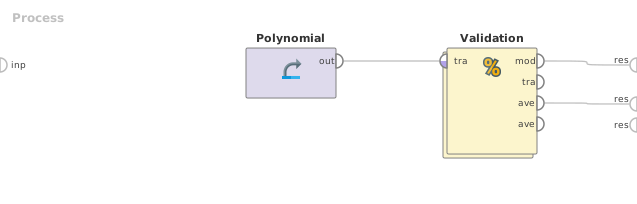
The 'Polynomial' information set up is loaded using the Retrieve operator. The Split Validation operator is applied on it for training and testing a regression model. The Relevance Vector Machine operator is applied in the training subprocess of the Split Validation operator. All parameters are used with default values. The Relevance Vector Machine operator generates a regression model. The Apply Model operator is used in the testing subprocess to utilise this model on the testing data set. The resultant labeled ExampleSet is used past the Operation operator for measuring the functioning of the model. The regression model and its performance vector are connected to the output and it tin can exist seen in the Results Workspace.
Source: https://docs.rapidminer.com/latest/studio/operators/modeling/predictive/functions/relevance_vector_machine.html
0 Response to "Relevance Vector Machine Tutorial or Survey or Review or Introduction or Outline"
Post a Comment