We Missed Each Other Again in Japanese
Japanese Are so Polite! 52 Weirdly Useful Phrases to Empathise Japanese Manners & Daily Life
Engagement published: 19 March 2020
Final updated: 29 September 2020
When visiting Nippon, in that location are several useful phrases y'all should probably know, every bit there may non exist many Japanese people who speak English language very fluently. But with these key phrases, whether shy or famous, any Japanese-speaking person you talk to will be sure to sympathise you.
Let'south look at some usually used expressions for situations you may encounter when visiting Japan in the following example sentences, along with their meanings and usage.
In this article:
・Greetings and Replies
・Useful Phrases When Lost
・Useful Phrases for Adaptation
・Eating house Phrases
・Phrases for Public Transport
・Sightseeing Phrases
・Shopping Phrases
Greetings, Replies, and More! Basic Phrases for Polish Conversation
The following are some essential, must-know phrases when communicating with Japanese people.
1. Ohayou-gozaimasu (おはようございます): Good morning
2. Kon'nichiwa (こんにちは): Hello (during daytime only)
three. Konbanwa (こんばんは): Good evening/hello (during evening/night)
In Japan, the words used in greeting vary depending on the fourth dimension of solar day: morning time, noon/daytime, and evening/night. In the mornings, say "Ohayou-gozaimasu" (lit. 'Good morning), during the day say "Kon'nichiwa," and in the evening/at dark, "Konbanwa" (lit. 'Expert evening').
4. Arigatou gozaimasu (ありがとうございます): Thank you
This is a phrase to express thank you and gratitude. Y'all tin shorten the phrase to "arigatou" in a casual situation, just "arigatou gozaimasu" is more polite. If somebody tells you "Arigatou gozaimasu," you tin reply with "Dou itashimashite (どういたしまして)," or "Yous're welcome."
v. Hai (はい): Yes
6. Iie (いいえ): No
Utilize "hai" as a positive/affirmative response in chat. To deny or negate, say "iie," or "no."
7. Sumimasen (すみません): Alibi me
This useful phrase can exist used as both an apology and as thanks, besides every bit to address a stranger or unfamiliar person. Its dash is quite similar to the English language equivalent "excuse me."
Useful Phrases When Lost
dimakig / Shutterstock.com
Hither are some useful phrases for if yous happen to lose your way. Even if this is the only thing you lot are able to say in Japanese, it volition be much easier for someone to assistance you out.
8. O-tazune shite mo ii desu ka? (おたずねしてもいいですか?): May I inquire you lot a question?
When asking someone for directions, this is a adept phrase to begin the interaction with. Alternatively, yous tin can use the previously mentioned "Sumimasen" (Excuse me). If they can help you, they volition probably respond, "Hai, 2 desu yo" (Yes, that's fine), and stop to assistance you. But if they say "Gomen nasai" or "Sumimasen" (both pregnant "I'm sorry"), they may not exist able to help you, so thank them and expect for someone else to ask.
9. ~ wa doko desu ka? (~はどこにありますか?): Where is ~?
Use this expression to inquire the location of your destination. Insert the proper noun of the place you're looking for where indicated by the ~.
10. Chizu o kaite moraemasu ka? (地図を書いてもらえますか?): Can you lot delight describe a map for me?
If you have trouble understanding directions that are given to you in Japanese, yous can enquire someone to depict yous a simple map. "Chizu" is the word for map. If yous have pen and a newspaper, you lot tin politely hand information technology to them every bit you enquire "Kaite moraemasu ka?" ("Can you please describe information technology?")
11. Koko wa doko desu ka? (ここはどこですか?): Where is this?/Where am I?
If y'all get lost, or don't know where you are, this expression is used to ask the proper name of the current location. "Koko" is the word for "hither," or your current location. If you lot have a map, yous can bear witness it to someone while asking this question so they can point out where you are.
Here are some other useful-to-know phrases:
12. Nihongo wa hanasemasen (日本語は話せません): I can't speak Japanese
This phrase lets the listener know that you cannot speak Japanese very well. You may desire to ask the other person if they can speak English with the following phrase: "Eigo wo hanasemasu ka?" ("Tin you speak English?") "Eigo" means English. You tin can modify the word "Eigo" to friction match your ain language if unlike from English.
13. Mou ichido onegaishimasu (もう一度お願いします): Can you lot please say that again?
If you can't hear or empathize the other person'due south reply the first time, yous can enquire them to repeat it with this phrase. It is also helpful to remember the phrase "Dou iu imi desu ka?" ("What does (information technology/this/that) mean?")
Useful Phrases for Hotels and Ryokan

Although English has become more widely bachelor in many accommodation facilities, there may exist some that are not as user-friendly for foreign visitors, such as a lack of multilingual staff and signs. But if you simply recall the minimum required Japanese phrases beneath, yous will be able access a greater range of facility options safely and with greater convenience.
14. Bank check-in (Bank check-out) o onegai-shimasu (チェックイン(チェックアウト)をお願いします): I would like to check-in/check-out
When you are ready to check in or out, only call out to the hotel staff with the words "Onegai-shimasu," which means "Please."
15. Aiteiru heya wa arimasu ka? (空いている部屋はありますか?): Are there whatever rooms bachelor?
If you have non fabricated a reservation beforehand, apply this phrase to ask if there is a vacant room, or "aiteiru heya." When there are no rooms bachelor, they may answer "manshitsu," or "full rooms."
16. Kore wa nan no ryokin desu ka? (これは何の料金ですか?): What is this charge for?
Some accommodations may have their ain unique rates and fee systems, which can exist confusing. Use this phrase if you find an unknown charge, or want to know what a certain charge is for.
17. Daiyokujou wa doko desu ka? (大浴場はどこですか?): Where is the public bath?
In Japan, there is a large public bathing area called "daiyokujou," which is shared with other guests. Some places even have an open up-air bath ("rotemburo," 露天風呂) where you lot can savour the scenery outside while you soak. You lot tin can ask where either of these areas are located with the question, "Daiyokujou/Rotemburo wa doko desu ka?" (Where is the public bath/open-air bathroom?)
eighteen. Chizu wa arimasu ka? (地図はありますか?): Do y'all have a map?
Use this phrase to request a map you tin can utilize so you can walk around after checking in. You can ask for any item you need by asking the question, "~ wa arimasu ka?" (Practice you have a ~?)
19. Chikaku ni o-susume no resutoran wa arimasu ka? (近くにおすすめのレストランはありますか?): Are at that place any recommended restaurants nearby?
If you can't decide which restaurant to consume at, inquire for a recommendation with this question. You can ask about various locations with the question, "Chikaku ni ~ wa arimasu ka?" (Is in that location a ~ nearby?)
twenty. Eigo no tsua wo shokai shite kudasai (英語のツアーを紹介してください): Please tell me most the English tour(s).
Some facilities offer various sightseeing tours for greenhorn visitors. This is a phrase that can be used when looking for a sightseeing bout with English-speaking guides.
21. Heya ni kagi wo wasuremashita (部屋にカギを忘れました): I forgot my key in the room
If you forget your cardinal in a room that auto-locks, use this phrase at the front desk-bound to have them open it for you. You tin can replace the discussion "kagi" with any item you forgot to say the expression, "~ o wasuremashita." (I forgot ~).
Ordering with Ease! Phrases to Apply in Restaurants
Alfonso Fernandez / Shutterstock.com
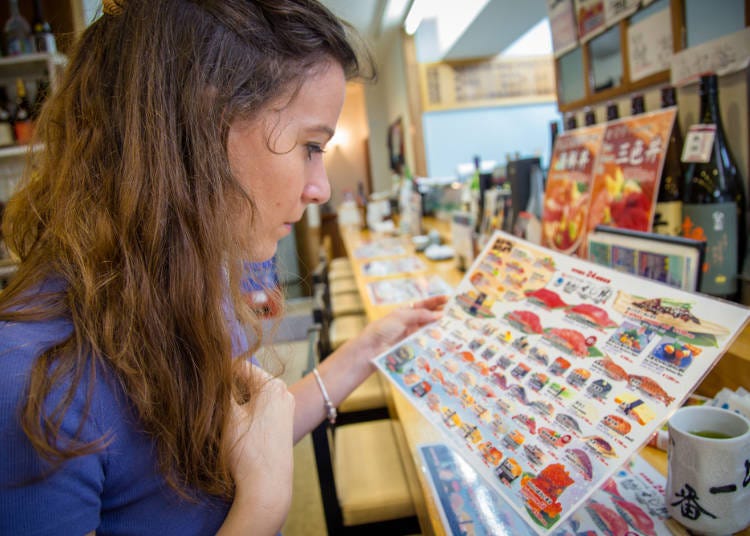
By learning how to club nutrient in Japanese, you will be able to more thoroughly enjoy eating your Japanese meals. There are many restaurants where English language may not exist available, so it's a practiced thought to report and use the phrases introduced beneath.
22. Carte o kudasai (メニューをください): Please requite me a carte
Say this when yous desire to see the menu. Y'all can modify the word with whatever you want and ask "~ o kudasai" (Please give me ~). If you want to ask for an English menu, inquire "Eigo no menu wa arimasu ka?" (Do yous accept an English bill of fare?)
23. Chumon o onegashimasu (注文をお願いします): I'm ready to order
In one case you accept decided what you desire to guild, allow the waiter know with this expression.
24. O-susume no menu wa dore desu ka? (おすすめのメニュ―はどれですか?): What carte du jour detail do y'all recommend?
If y'all don't know which one to choose, or only desire to know the staff-picked recommendations, you tin use this phrase to ask them.
25. Kore wa nan desu ka? (これは何ですか?): What is this?
This is useful when you want to know what an ingredient is, especially if there are certain things you cannot consume. Use this phrase to enquire virtually what you want to know, using the word "kore" to signal "this."
26. Kore o onegaishimasu (これをお願いします): I'd similar (to order) this, please
You can easily order something by pointing to it on the menu and maxim, "Kore o onegaishimasu" (I would similar to club this).
27. Kohi wa tsukimasu ka? (コーヒーはつきますか?): Does information technology include coffee?
When ordering a set carte, they sometimes include java. You can ask whether they do or non with this phrase.
28. Mizu o onegaishimasu (水をお願いします): Please give me some water
In Japanese restaurants, it is common to serve complimentary water to guests subsequently they take their seats. Yous can as well use this phrase "Mizu o onegaishimasu" (Please requite me some water) if the water you lot were drinking has finished to enquire for a refill.
29. Toire wa doko desu ka? (トイレはどこですか?): Where is the bathroom?
This is a user-friendly expression when asking the location of the restrooms in whatsoever identify, not just in the restaurants.
thirty. Itadakimasu (いただきます): Phrase said before eating food
31: Gochisosama deshita (ごちそうさまでした): Phrase said after eating; likewise means "Thanks for the meal."
In Japan, it is customary to say "Itadakimasu" before eating (literally, "I receive [the food]), and "Gochisosama deshita" ("Thank you lot for the meal") when you are done eating. These both express gratitude to the people who prepared the meal, then please use to show your appreciation. It is also polite to say the expression "Gochisosama deshita" to the restaurants forepart staff before leaving.
32. O-kaikei o onegaishimasu (お会計をお願いします): Check delight
This phrase is used when yous are gear up to pay after finishing your meal. In some places they will still bring yous the check if you tell the staff the previous phrase, "Gochisosama deshita."
Phrases to Get Around the Station and in the Train

Trains are a convenient way to travel in Japan, but depending on the location, railroad train routes and transfers tin can be complicated, making it easy to get lost. But if you lot retrieve these phrases, you tin get around with ease.
33. Kippu uriba wa doko desu ka? (切符売り場はどこですか?): Where can I buy tickets?
Use this phrase when you want to know where the ticket window is, or where y'all tin can buy tickets. Tickets can exist sold at automatic vending machines, as well equally at the counter where the staff can help.
34. ~ made no kippu o kudasai (までの切符をください): Delight give me a ticket to ~
When buying a ticket at the window, utilize this phrase and insert the name of your destination in the ~.
35. ~ ni wa dou ikeba ii desu ka? (にはどう行けばいいですか?): How do I get to ~?
If the route map is complicated and you tin't figure out where to transfer, you can ask for directions past using this expression and replacing the ~ with the proper noun of the station you want to get to.
36. ~ yuki no densha wa dore desu ka? (行きの電車はどれですか?): Which train goes to ~?
This phrase is used to ask at which platform you can have your desired train. Replace ~ with the proper noun of the station you are trying to get to.
37. Kono densha wa ~ ni ikimasu ka? (この電車は○○に行きますか): Does this railroad train go to ~?
Use this to ask if the train you are on (or are asking about) goes to your desired station. Replace the ~ with the station proper name you want, and brand sure you don't accidentally take the wrong train.
38. Tsugi no ~ yuki wa nanji desu ka? (次の○○行きは何時ですか?): What time is the adjacent railroad train to ~?
Use this phrase to ask what time the next railroad train to your desired location will leave. Replace ~ with the name of the station.
39. Koko wa nan eki desu ka? (ここは何駅ですか?): What station is this?
If you lot do non know or cannot read the name of the station your railroad train has arrived at, yous can ask another passenger this question to check. When yous desire to know the name of the next end yous can enquire, "Tsugi wa nan eki desu ka?" (次は何駅ですか; "What station is next?")
twoscore. Orimasu (降ります): I'm getting off (omnibus or train)
If you arrive at your desired station but the train car is crowded, you can use this phrase to let other passengers know yous are trying to get out.
Getting Useful Information: Phrases for Sightseeing
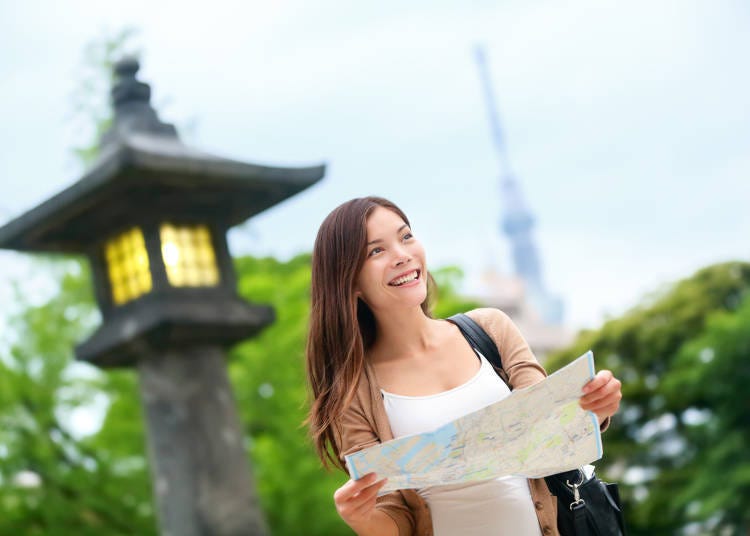
Speaking in Japanese may aid you learn information in a style only obtainable by using the local language.
41. Kankou-annai-jou wa doko desu ka? (観光案内所はどこですか?): Where is the tourist data center?
This phrase is used to ask the location of the tourist information centre. The Tourist Information Centre (kankou-annai-jou) has tons of useful data for sightseeing.
42. Pamfuretto wa arimasu ka? (パンフレットはありますか?): Are at that place any brochures?
Use this phrase to ask for an information brochure with more detailed information on tourist attractions.
43. Shashin o totte mo ii desu ka? (写真を撮ってもいいですか?): May I accept a photograph?
This expression is used to inquire for permission to take pictures. You can use information technology when asking if photography is allowed in a sure area, as well as to ask people if you lot can accept a photo of or with them (such as when you desire a photo of someone wearing a kimono).
44. Shashin o totte moraemasu ka? (写真を撮ってもらえますか?): Can y'all delight take a picture (for me)?
This phrase is used when yous want to ask someone to take a movie of/for you lot. Don't forget to say "Arigatou gozaimasu," or "Thank you," to the person who takes the picture for you.
45. Takushii noriba wa doko desu ka? (タクシー乗り場はどこですか?): Where is the taxi stand?
Utilise this when looking for a spot you can catch a taxi. If looking for a bus stop, ask "Basu noriba wa doko desu ka?" (バス乗り場はどこですか?; "Where is the bus stop?")
46. Koko ni itte kudasai (ここに行ってください): Please go here
When taking a taxi, you tin easily tell the taxi driver where you desire by pointing out the location on the map and saying "koko," or "here." You tin also replace "koko" in the expression with the name of a specific location ("~ ni itte kudasai") to specifically tell the driver where yous want to go.
Useful Phrases for Shopping

While some stores may have staff who can speak foreign languages in popular tourist destinations, there are still many stores that can only speak Japanese.
47. Kore o misete kudasai (これを見せてください): Please show me this
Employ this phrase to ask a clerk to show you a product in a display case.
48. Kichaku shite mo ii desu ka? (試着してもいいですか?): Tin I endeavour it on?
When clothes shopping, trying items on is called "kichaku." Japanese clothes are ofttimes smaller than in the West, so it is a expert idea to use this phrase and try them on earlier ownership.
49. ~ wa arimasu ka? (はありますか?): Practise you take ~?
Utilise this phrase to inquire the store clerk for an item you are looking for. Replace the ~ with the name of the product you want.
l. Kore o kudasai (これをください): I'll take this
One time you have decided on your items, employ this expression to indicate what you desire to buy.
51. Ikura desu ka? (いくらですか?): How much is it/this?
Use this phrase to ask the price of items. When you want to know the price of a specific detail, yous tin signal at information technology and ask "Ikura desu ka?" If you want to inquire the total price of several items, you tin ask "Zenbu de ikura desu ka?" (全部でいくらですか?; How much is all of this?)
52. Kurejitto kado wa tsukaemasu ka? (クレジットカードは使えますか?): Tin can I utilize a credit card?
If planning to use a credit card, you lot may want to ask this phrase in accelerate, earlier doing your shopping. Some stores do not have credit cards.
By understanding and using these useful phrases, yous are now well prepared for actively communicating with the Japanese locals during your visit to Japan. With these, you are sure to exist able to create even more than wonderful memories during your trip!
Written by Yoko. English translation by Krys Suzuki.
*This information is from the time of this article's publication.
*Prices and options mentioned are subject to change.
*Unless stated otherwise, all prices include taxation.
Source: https://livejapan.com/en/in-tokyo/in-pref-tokyo/in-tokyo_train_station/article-a0003255/
0 Response to "We Missed Each Other Again in Japanese"
Post a Comment